
LGI Homes
US company growing intrinsic value at 22% CAGR for 12 years, trading at 50% of book value, buying back shares

Today’s write-up covers a company we have been following for several years, and is highly misunderstood by the market today.
It’s one of the most interesting setups we have ever seen, because it
Is founder-led and owned
Delivered ~50 consecutive profitable quarters since IPO
Compounded value per share at 22% CAGR over 12 years (11x !! )
Trades at 0.5x price / book (10x P/E)
Reported 8% bookings growth, 20% backlog growth in Q3 2025
Bought back 2% of its shares in the past 12 months
Considers one-off asset sales to increase buybacks
Surged 3x in 4 months the last time it traded below book (03/2020)
Write-up Nov 9th, 2025:
Overview
LGI Homes is a U.S. homebuilder, delivering entry-level single-family homes (95%) and townhomes (5%). The company is mostly active in the Sun Belt, and has ~6,000 annual closings, or ~1% of the U.S. new-home market. The company offers homes in 21 states.
History of the company and the founders
LGI was founded by Thomas Lipar in the 1990s, who together with his son Eric, started a land development business called LGI (Lipar Group Inc). The company was initially focused on acquiring undervalued raw land in emerging suburban areas, and developing it into empty plots ready to be built on. This involves going through regulatory processes like zoning and entitlements, as well as preparing the sites with essential infrastructure such as roads, utilities and drainage, before selling them to home builders.
In 2003, Thomas and Eric renamed the company to LGI Homes, and entered the Texas housing market with their inaugural homebuilding project in Conroe, a fast-growing suburb north of Houston. This first community included 337 affordable, energy-efficient starter homes designed for first-time buyers and young families. Priced under $150,000 at the time, these quick-move-in properties quickly gained traction, setting the foundation for LGI’s expansion across the state and beyond.
The Lipars consistently focused on building entry-level homes for first time buyers, aiming to increase the number of Americans able to own their home. The company has often selected cheap land near rental communities, developed the land, and sent out flyers to the nearby renters, showing the small monthly difference in mortgage payments vs rent expenses to attract buyers.
In 2013, LGIH went public at a ~$250m market cap. The market had high expectations of the Lipars, given their incredible performance up to that point. In fact, driven by their smart land acquisition and development strategies, vertically integrated with their home building business, they were the only one among the 200 largest U.S. home builders to deliver profits and growth throughout the 2005-2010 global financial crisis. Page 63 of LGIH’s 2013 IPO prospectus reads:
“Since commencing operations in 2003, we have constructed and sold over 5,000 homes, have been profitable every year despite the housing downturn, and have never taken an inventory impairment. According to Builder magazine, we were the only homebuilder among the 200 largest U.S. homebuilders to report closings and revenue growth from 2006 to 2008 when the housing market experienced a significant decline. We increased our revenue from $55.3 million ($50.5 million for our predecessor) in 2010 to $143.4 million ($76.2 million for our predecessor) in 2012, representing a compound annual growth rate of 61.0% (20.2% for our predecessor). We increased our closings from 439 homes in 2010 to 1,062 homes in 2012. Among our public homebuilder peers, we had the highest revenue and closings growth between 2010 and 2012. Since 2010, we achieved profitability within six months of our first home closings in each of our new communities in these markets.”
49 consecutive profitable quarters, driving
22% CAGR in book value per share
Since the 2013 IPO, the company has continued firing on all cylinders, being profitable every single quarter. This consistent profitability leads LGIH’s book value per share to rise, every single quarter as well:
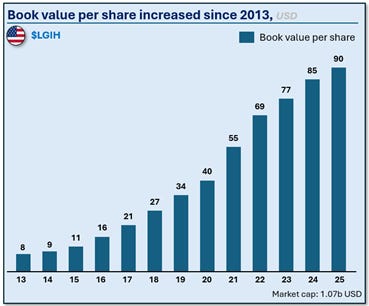
As shown in the chart, LGI Homes grew per share book value from $8 to $90 in 12 years, for an impressive 22% CAGR, while paying small dividends along the way. This is testament to the Lipars lifelong craftsmanship of selecting the right lands, developing them into construction areas, and building attractive single-family homes on them, while opportunistically buying back stock when it is offered at a discount.
The housing cycle
LGI Homes achieves a ~20-25% average Return on Equity through the cycle, as necessary for its stellar book value per share growth. The past 2-3 years have been tough for housing, as we can see in the chart below or read in the corresponding article.
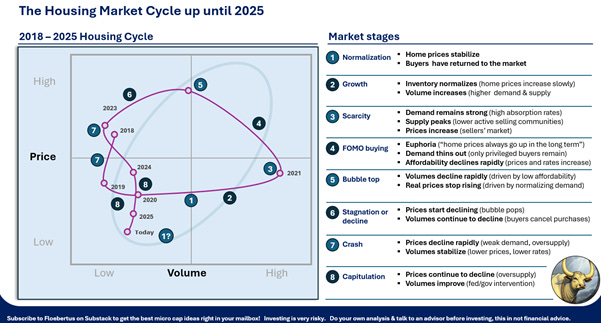

Rising interest rates have put a strain on affordability, causing home prices and home sales to stop rising and start to decline. In a typical year in the United States:
Slightly more houses are sold than the year before (0-1%)
Home prices increase ~4-5%
First-time buyers represent ~30% of new home buyers
Monthly costs of new mortgages are somewhat higher than rental alternatives
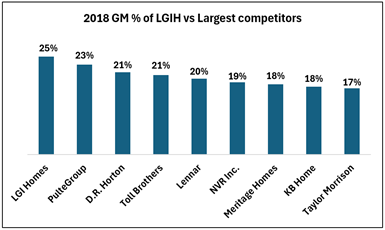
This creates a healthy environment for LGIH to convert their opportunistically acquired land into new homes and convert nearby renters into buyers. With every year passing, the assets LGIH hold (homes and land) increase in value. This provides a tailwind to Gross Margins, which asset-lighter competitors don’t have, because in a good market, the homes LGIH sells have been built on land that has appreciated significantly over the years the company held it.
This is why LGIH has the highest Gross Margins in the industry in such a market, and has consistently had about the largest GMs from ~2015-2021:
In 2024 and 2025 however:
Marginally more houses are sold than the year before
Home prices declined 1% YTD 25 (and even -2% for 2024)
First-time buyers represent ~21% of total home buyers in 2025 so far
Mortgage rates at 6-8% making buying significantly harder than renting
This causes LGIH to currently have more normal looking margins compared to competitors, not feeling the tailwind from holding land rather than land call options.
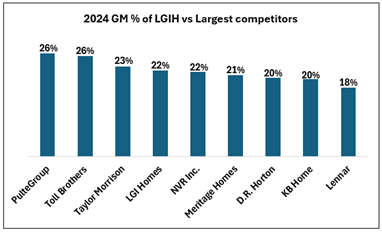
Besides the lack of land value appreciation, and home prices appreciation, and overall demand softness in housing, the current cyclical headwind is hitting LGIH extra hard. Higher interest rates are pushing first-time buyers out of the new homes market, as mortgages for new homes are currently much more expensive than monthly rent alternatives. This makes it extremely hard for LGIH’s target customer to buy a new home in 2024 and 2025.
LGIH’s performance in the 12 months until Oct 2025
Looking at how LGIH does during these tough years, we see that in the last 12 months:
Revenue was ~$1.8 billion, vs $2.2b the year prior (-18%)
Profits were $106m, vs $197m the year prior (-46%)
Book value increased from $2b to $2.08b (+4%)
Basic shares out reduced from 23.5 to 23.1 by (-2%)
Book value per share increased from $85 to $90 (+6%)
(No Dividend)
It’s remarkable that a 6% increase in Book Value Per Share is a bad year for LGIH, given that a good year is a 25-35% increase. There seem to be many more good years than bad years through the cycle, leading to LGIH’s 22% CAGR. The company clearly knows the art of consistently adding value, although the stock market does not always notice it immediately.
The market did like LGIH’s Q3 results, because the company stated:
- Q3 Sales orders for new homes were 8% higher than the year before
- Q3 ending order backlog was 20% higher than a year before
- LGIH is looking into selling lower priority land assets, for debt reduction
- LGIH is looking forward to buying back more shares in 2026
While this provides signs that the market may be improving and management may be able to quickly reduce the book value discount by selling assets and buying stock, LGIH is clearly not out of the woods yet, and guided for ~20% lower Q4 revenues. Longer term though, we think the housing cycle will turn and LGIH will get priced well above book value again as first-time buyers return to the market.
Current valuation
LGIH currently trades at 0.52x book value. We think the company is worth ~1.2x-1.5x book value, given its long-term track record compounding value at above 20% ROE.
The current share price is equal to 10x LTM EPS. We prefer not to value LGIH based on an earnings multiple though, given (1) They could achieve significantly higher short term earnings by lowering prices, should they like to (2) Regardless of current earnings, they own the houses and the land, and we think both are worth more than historical book value and (3) earnings of cyclical companies always look the worst at the best possible time to buy them and best at the worst possible time to buy them.
Note that in 2020 and 2021, book value per share (in chart 1 above) increased very significantly as the housing market was very strong. People had just spent their whole 24/7 life stuck inside their homes or apartments during Covid and couldn’t wait to buy a new home. Credit was cheap and rising inflation and interest rates were whispering fear into the ears of first-time buyers. “It’s now or never… “.
This caused LGIH’s book value to increase 72% in 2 years! One might think that real estate investors would turn cautious in such an environment, but instead they bid up LGI Homes to over 2x, and some days even 3x book value.
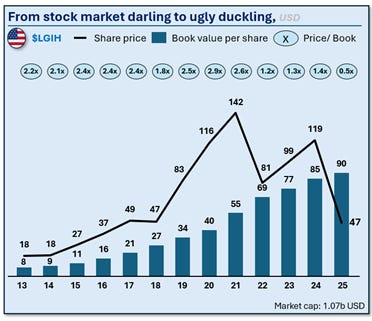
The market didn’t think LGI Homes was going to sell their inventory at 3x book value in 2021, but the market’s reliance on P/E ratio did create a stock price which implied a decade of growth at above average margins, which is possible but extremely unrealistic.
Similarly, we think today’s assessment of the market, pricing LGIH at 0.5x book, which implies a decade of low single digits Returns on Equity, is possible but extremely unrealistic.
We think LGI Homes is worth ~1.2-1.5x book value, or $108 – 135 per share. The next time it gets there though, it will likely be posting double-digit growth rates, the P/E will likely be lower than today, and the market will likely take it back to well above 2x book value before correcting, as it did in previous cycles.
What we have seen in previous cycles is that LGI Homes stock price keeps rallying well after the housing market overheats and the Fed starts rising interest rates. Similarly, today, investors are selling off LGIH while the first rate cuts provide signs of improvement for the housing market.
Why the opportunity exists
We think the opportunity exists because:
Investors predominantly rely on profit-based valuations, not suited to value a cyclical, interest-rate dependent company like LGIH.
Investors in LGIH throw in the towel after multiple years of softness in the housing market, particularly at the low end served by LGIH
The market cap of LGIH has declined from $4 Billion to <1 billion, likely causing some forced selling among institutional holders limited to companies with market cap > 1 or 2 billion USD, or linked to daily USD liquidity constraints
Tax loss harvesting, the stock being down ~50% coming into November
Lack of imminent turn around. While it is appealing to buy a profitable business at 50% of the value of its real estate assets, it’s not clear when the market will turn around. Compared to 1 year ago, not much has improved. In fact, margins have deteriorated and book value increased by only 6%. There is no narrative here of how and when improvement will occur. This makes it hard for investors to buy or justify buying LGIH, even trading at 50% of book value.
Risks
Land and Home prices may decline because of population/migration declines
Competition in the housing market may increase, suppressing margins
Rising interest rates may cause continued weak demand and worsening credit availability, causing the company to raise capital through an equity financing
Government regulation to unlock existing housing inventory may negatively affect home builders
Summary
LGIH has a strong track record of growing book value per share by ~20% per year, under the leadership of its founders. The stock is being thrown out after a couple of bad years in the housing market, first-time buyers staying out of the market due to rising mortgage rates. We think LGIH will quickly revert back to 1.2-1.5x book value.
Disclaimer
This publication’s authors are not licensed investment professionals. Nothing produced by the Floebertus team should be construed as investment advice. Investing involves serious risks, including risk of capital. Do your own research before investing, and size your positions appropriately, in line with your own conviction and your own knowledge.
In my opinion a EV to book value is a more accurate measurement of valuation of LGIH compared to P/B value. They have significantly increased their leverage, inflating EV. What are your thoughts on this?
What is driving the BVPS increase? If they remarked asset prices based on peak selling value then might not be such a discount to "true" BV.
Compelling opportunity as there's still a large gap in needed homes since 2008 so its not like demand is going to disappear (only hides when rates are high)